Evaluating Party Night: A Practical Guide to Bold Display Typography
In the realm of graphic design, selecting the right typeface is often the difference between a message that resonates and one that gets overlooked. For projects centered around celebration, festivity, and high-energy events, Party Night has emerged as a significant option for designers seeking a distinct visual voice. As a bold display font, it is engineered to capture the immediate excitement of celebrations through its thick letterforms and lively structure. However, like any specialized tool, it serves specific purposes best and may not be suitable for every context. Understanding the nuances of Party Night, its strengths, and where it fits within the broader landscape of display typography is essential for making informed design decisions.
Defining the Visual Identity of Party Night
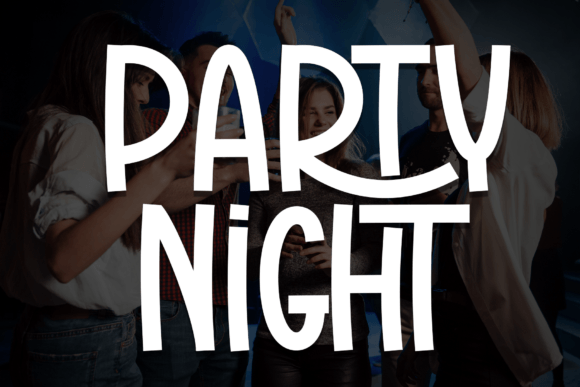
Party Night belongs to the category of display fonts, which are designed specifically for large sizes and short bursts of text rather than extended reading. Its defining characteristic is its weight; the letters are thick and substantial, ensuring they command attention from a distance. This makes the font inherently loud in a visual sense, mirroring the auditory energy of a party environment. The style is playful yet structured, avoiding the chaotic irregularity of some hand-drawn scripts while maintaining enough personality to feel organic and festive.
What distinguishes Party Night from standard sans-serif or serif bold fonts is its intentional exaggeration. The curves are rounded, the terminals are often softened, and the overall proportions suggest movement and joy. When applied to a canvas, the font does not sit passively; it projects an attitude. This makes it particularly effective for headlines, logos, and titles where the primary goal is to establish a mood instantly. For adults managing event planning or brand identity, recognizing this inherent "loudness" is crucial. It is not a neutral vessel for information; it is an active participant in the communication strategy.
Comparing Party Night with Other Display Categories
When evaluating Party Night, it is helpful to compare it against other common typographic approaches used in celebratory contexts. One frequent alternative is the use of script or cursive fonts. While scripts offer elegance and fluidity, they can sometimes sacrifice legibility, especially at smaller sizes or when viewed quickly. Party Night offers a middle ground: it retains the playfulness associated with handwritten styles but maintains the structural integrity of block letters. This results in higher readability without sacrificing the festive vibe.
Another comparison point is the use of ultra-bold geometric sans-serifs. Fonts in this category are clean, modern, and impactful, but they often lack the specific "party" connotation. They convey strength and stability, which might be appropriate for corporate galas or formal dinners but could feel too sterile for a birthday bash or a casual gathering. Party Night introduces a layer of whimsy that geometric fonts typically omit. The tradeoff here is specificity versus versatility. If the goal is a generic bold statement, a geometric font works well. If the goal is to signal "celebration" immediately, Party Night provides a more direct semantic link.
Furthermore, compared to retro or vintage-style display fonts, Party Night feels contemporary. Retro fonts often rely on distressed textures or specific historical shapes that evoke a bygone era. While effective for themed parties, they limit the scope of the design. Party Night is designed to feel current, allowing it to integrate seamlessly into modern digital interfaces and print materials alike. This temporal neutrality gives it an advantage for events that do not adhere to a strict historical theme but still require a vibrant aesthetic.
Legibility and Scale Considerations
A critical factor in choosing Party Night is understanding how it behaves across different scales. Because the strokes are so thick, the font thrives in large formats such as posters, banners, and billboards. At these sizes, the details of the letterforms are visible, and the weight creates a strong silhouette that cuts through visual noise. However, as the size decreases, the thickness can become a liability. In body copy or small print, the heavy strokes may merge, causing the text to appear as solid blocks rather than distinct characters.
This limitation dictates that Party Night should be reserved for headlines, subheads, and call-to-action buttons. It is rarely the right choice for paragraphs, lists, or instructional text. Designers must evaluate the hierarchy of their layout carefully. Using Party Night for a main title paired with a clean, lightweight sans-serif for body text creates a balanced contrast that guides the reader's eye effectively. Attempting to use the font for everything often leads to visual fatigue and reduced comprehension.
Best-Fit Situations and Use Cases
The most effective applications for Party Night are those where the primary objective is to generate enthusiasm and draw immediate attention. Posters for music festivals, club nights, or community gatherings benefit significantly from this typeface. The bold nature of the letters ensures that the event name stands out even when viewed peripherally. Similarly, digital invitations sent via email or social media platforms utilize the font's impact to stop the scroll. In a feed crowded with images and varied content, a headline set in Party Night acts as a visual anchor.
Beyond physical and digital invites, the font is highly versatile for merchandise and decor. T-shirts, tote bags, and temporary tattoos often rely on simple, bold graphics. Party Night translates well to these mediums because the thick lines hold up during the printing process, whether it is screen printing, vinyl cutting, or heat transfer. Unlike thin fonts that might break or fade, the robust structure of this typeface ensures durability and clarity on fabric and paper.
For branding, Party Night can serve as a logo element for businesses in the entertainment, hospitality, or lifestyle sectors. A bar, a party rental service, or an event planning agency might use the font to communicate their core value proposition: fun and energy. However, it requires careful application. The font should be part of a cohesive system that includes colors and imagery that support the tone. Without supporting elements, the font alone might feel one-dimensional.
Tradeoffs and Limitations to Consider
While Party Night excels in specific scenarios, it is not a universal solution. The primary tradeoff is its lack of subtlety. Because the font is so expressive, it can clash with designs that aim for sophistication, minimalism, or seriousness. Using it for a wedding invitation, for example, might send the wrong message unless the couple explicitly wants a very casual, non-traditional vibe. The font's inherent informality can undermine attempts to convey prestige or exclusivity.
Additionally, the limited character set often found in display fonts like Party Night can restrict creative flexibility. Many display fonts come with only uppercase letters, or a limited range of numbers and punctuation. Designers must verify the availability of all necessary glyphs before committing to the font for a project. If a project requires complex formatting or extensive text in the display style, the lack of a full character set can force a compromise in the design layout.
Another consideration is the potential for overuse. Because the font is so distinctive, using it repeatedly across different materials can lead to brand fatigue. It is most effective when used sparingly to highlight key information. Overloading a design with Party Night can make the content feel cluttered and aggressive, detracting from the actual message. Balance is key; the font should act as a highlighter, not the entire document.
Decision Factors for Selecting Party Night
When deciding whether Party Night is the right choice for a project, several practical factors should guide the evaluation. First, consider the audience. Is the target demographic likely to respond to a bold, energetic aesthetic? For younger crowds or casual events, the answer is usually yes. For more conservative audiences, a different approach might be safer. Second, assess the medium. Will the text be seen from a distance or up close? If it is for a large poster, the font's weight is an asset. If it is for a small business card, the limitations of legibility become a concern.
Third, evaluate the existing design system. Does the color palette and imagery support the playful nature of the font? Party Night works best with vibrant colors and dynamic layouts. Pairing it with muted tones or rigid grids can create a dissonance that confuses the viewer. Finally, think about longevity. Trends in typography shift, but the core appeal of bold, readable display fonts remains relatively stable. However, if the goal is a timeless brand identity, ensure that the specific stylistic choices of Party Night will not date the design prematurely.
Ultimately, the decision to use Party Night comes down to alignment between the font's characteristics and the project's goals. It is a powerful tool for capturing the spirit of celebration, offering a visual shorthand for fun and excitement. By understanding its strengths in creating impact and its limitations in versatility and legibility, designers and planners can leverage it effectively. Whether for a one-off event poster or a recurring brand element, the font succeeds when it is chosen deliberately to match the energy of the occasion, ensuring that the message is not just read, but felt.