Vintage Arrow: A Practical Evaluation of a Thematic Dingbats Font
In the crowded landscape of digital typography, finding a font that balances whimsy with professional utility is often a challenge. Vintage Arrow emerges as a distinct option for designers seeking to inject a sense of nostalgia and directionality into their work without relying on generic vector shapes. As a cute dingbats font with a fun theme, it serves a specific niche within the creative industry, offering a collection of stylized arrows, decorative elements, and thematic icons that function as typographic assets rather than standard text characters. For professionals ranging from wedding planners to small business owners, understanding the practical application and limitations of this typeface is essential before integrating it into a production workflow.
Defining the Character and Utility of Vintage Arrow
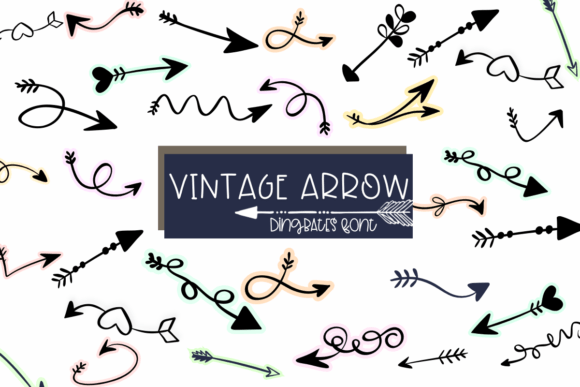
At its core, Vintage Arrow is not designed for body copy or long-form reading. Instead, it operates as a symbol set, where each keystroke generates a unique graphic element. These elements typically include various arrow styles—feathered, straight, curved, and ornate—alongside complementary motifs like stars, hearts, and floral accents that align with a retro aesthetic. The "cute" descriptor in its marketing is accurate; the lines are often soft, the curves gentle, and the overall feel lighthearted. This makes it immediately suitable for projects requiring a touch of charm or a vintage-inspired narrative.
The value of Vintage Arrow lies in its ability to unify visual language across a project. Rather than importing separate PNG or SVG files for directional cues or decorative borders, a designer can utilize the font directly within their layout software. This streamlines the process of creating consistent branding elements. For instance, a logo requiring a subtle directional flow can be constructed entirely within the font's character set, ensuring that every curve and line weight matches perfectly. This consistency is a significant advantage when scaling designs for different media formats.
Design Characteristics and Visual Consistency
When evaluating the technical quality of Vintage Arrow, several key characteristics stand out. The stroke weight is generally uniform, which contributes to a clean appearance even at smaller sizes. Unlike many free dingbat fonts that suffer from jagged edges or inconsistent spacing, this typeface maintains a level of polish that suggests careful kerning and glyph construction. The variety within the set is also noteworthy; it does not simply offer ten variations of the same arrow but provides a range of orientations and styles that allow for dynamic compositions.
However, the aesthetic is inherently tied to a specific era and mood. The design leans heavily into a mid-century or rustic chic vibe. While this is a strength for targeted projects, it limits the font's versatility in modern, minimalist, or high-tech contexts. The "fun theme" means that using these glyphs in a serious corporate report or a medical document would likely be inappropriate. The visual language speaks clearly of celebration, guidance, and playfulness, which dictates its appropriate use cases.
Strengths in Creative Applications
The primary strength of Vintage Arrow is its adaptability in decorative contexts. It excels in scenarios where visual hierarchy needs to be established through iconography rather than size alone. In wedding invitations, for example, the font can frame names, guide the eye to the RSVP section, or create intricate dividers between text blocks. The organic nature of the arrows complements hand-lettered scripts and serif fonts commonly used in stationery, creating a cohesive vintage look.
For DIY enthusiasts and crafters, the font offers immediate value in print-and-cut workflows. Users can generate custom stickers, scrapbook embellishments, or stencil patterns by typing the desired symbols and exporting them as vectors. This eliminates the need to hunt for matching clip art, saving time and ensuring that all elements share the same stylistic DNA. The reliability of the font rendering ensures that when printed, the details remain sharp, provided the output resolution is adequate.
Real-World Performance and Workflow Integration
From a practical standpoint, integrating Vintage Arrow into a professional workflow is straightforward. Most modern design software, including Adobe Illustrator, Photoshop, InDesign, and Canva, supports dingbat fonts natively. The user experience is seamless: select the font, type the corresponding keys, and manipulate the resulting graphics as you would any other text layer. This flexibility allows for quick iterations. If a client requests a change in the direction of an arrow or the style of a divider, the designer can simply swap the character code rather than redrawing the asset from scratch.
One area where the font performs well is in logo design for lifestyle brands. Small businesses selling handmade goods, boutique cafes, or event planning services often require logos that feel personal and approachable. Vintage Arrow provides the necessary graphical vocabulary to construct such identities. By combining a few selected glyphs with a strong serif or script typeface, a designer can create a memorable mark that stands out in a saturated market. The font's scalability ensures that the logo remains legible whether it appears on a business card or a storefront sign.
Limitations and Considerations for Professional Use
Despite its strengths, Vintage Arrow has clear limitations that users must acknowledge. Because it is a dingbat font, it lacks the linguistic depth required for communication. It cannot convey complex messages on its own. Furthermore, the file format compatibility, while generally good, may vary depending on the operating system and software version. Designers should always embed the font or convert text to outlines before sharing files with printers or clients to prevent substitution errors.
Another consideration is the potential for overuse. The "cute" and "fun" nature of the font can easily tip into clutter if too many elements are introduced into a single layout. Effective design relies on negative space and restraint. When using Vintage Arrow, it is crucial to treat the symbols as punctuation rather than the main sentence. Overloading a page with arrows and decorative flourishes can distract from the core message and diminish the professional quality of the work.
Situational Fit and Audience Alignment
The font is best suited for audiences aged 20–50 who appreciate a blend of nostalgia and modern functionality. It resonates particularly well with entrepreneurs in the wedding, event, and artisanal sectors. Educators creating classroom materials might also find value in its engaging visual style for headers and activity guides. However, it is less effective for industries requiring strict adherence to corporate identity guidelines that favor minimalism or futurism.
For freelancers and bloggers, Vintage Arrow offers a cost-effective way to enhance content presentation. It can be used to create custom bullet points, section dividers, or social media graphics that maintain brand consistency without the expense of hiring an illustrator for every asset. The long-term value lies in its versatility across multiple project types, allowing creators to build a library of reusable templates that leverage the font's unique character set.
Final Assessment and Recommendations
Vintage Arrow is a specialized tool that delivers significant value when applied correctly. It is not a universal solution for all typographic needs, but for projects requiring a vintage, playful, or decorative touch, it is a robust resource. Its strength lies in its consistency, ease of use, and the wide variety of thematic elements it provides. Professionals who understand its limitations regarding readability and context will find it to be a reliable addition to their toolkit.
Ultimately, the decision to use Vintage Arrow should depend on the specific goals of the project. If the objective is to create a warm, inviting, and visually interesting piece of communication, this font is highly recommended. For those focused on efficiency and creative expression, it offers a streamlined path to achieving a polished, retro-inspired aesthetic. By leveraging its unique dingbat capabilities, designers can elevate their work, adding a layer of personality that standard typefaces simply cannot provide.