Concur Sans Serif: A Modern Type Family Bridging Swiss Precision and Geometric Warmth
In the vast landscape of digital and print design, typography serves as the silent ambassador of a brand's voice. It is the invisible architecture that guides the reader's eye, dictates the rhythm of consumption, and establishes trust before a single word is fully processed. Among the contemporary typefaces rising to prominence in recent years, Concur Sans Serif Font Family has emerged as a standout contender. This versatile workhorse is not merely a collection of characters; it is a carefully engineered system that synthesizes the rigorous clarity of Swiss neo-grotesks with the approachable warmth of geometric fonts. Whether you are a graphic designer crafting a logo, a web developer optimizing for screen readability, or a business owner refining your brand identity, understanding the nuances of Concur Sans can elevate your visual communication strategy.
The Genesis of a Hybrid Typeface
To truly appreciate Concur Sans, one must first understand the two distinct typographic traditions it unites. The "Swiss" style, often referred to as International Typographic Style, is renowned for its objectivity, grid-based layouts, and lack of ornamentation. Fonts like Helvetica are the poster children of this movement, prioritizing legibility and neutrality above all else. On the other hand, geometric sans-serifs are constructed using simple shapes—circles, squares, and triangles—resulting in a look that feels modern, friendly, and sometimes even playful.
Concur Sans Serif acts as a bridge between these two worlds. It takes the structural integrity and professional reliability of the Swiss tradition but infuses it with the subtle curves and open apertures characteristic of geometric designs. The result is a typeface that feels authoritative yet inviting. This hybrid nature makes it particularly effective in today's design environment, where brands strive to appear both competent and human-centric. By combining these best qualities, Concur avoids the coldness that can sometimes plague strict neo-grotesks while maintaining the sophistication required for high-end corporate applications.
A Multifunctional Workhorse for Diverse Contexts
The true test of a great font family is its versatility. Can it handle a massive billboard headline with the same grace as a tiny footnote in a legal document? Concur Sans was designed with this multifunctionality at its core. It is built to perform seamlessly across a wide spectrum of media, ensuring consistency whether the content is viewed on a high-resolution monitor, a mobile device, or printed on textured paper.
- Logo Design: In branding, every stroke counts. Concur Sans offers clean lines and balanced proportions that allow logos to remain recognizable even when scaled down to a favicon or embossed on stationery. Its neutral character ensures that the brand name remains the focal point without the typeface imposing an unwanted personality.
- Brand Identities: For comprehensive brand systems, the font provides a cohesive visual language. From business cards to annual reports, the consistent weight distribution creates a unified aesthetic that reinforces brand recognition.
- Websites and UI/UX: In the digital realm, readability is paramount. The upright versions of Concur Sans are optimized for screen rendering, ensuring that text remains crisp on various pixel densities. This makes it an excellent choice for user interfaces, navigation menus, and body copy on websites.
- Packaging and Posters: When used in large formats, the geometric influences shine through. The bold weights command attention, making them ideal for headlines on posters or product packaging where immediate impact is necessary.
Anatomy of the Font Family: Weights and Styles
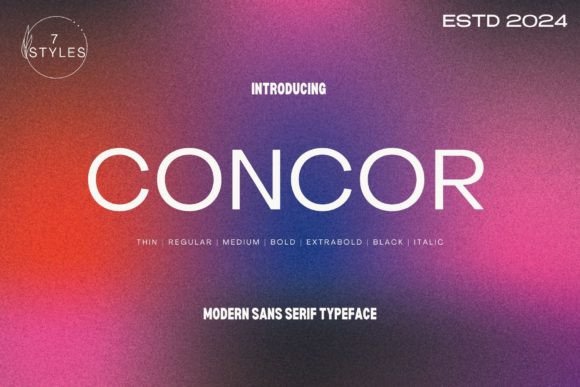
A robust type family requires a range of options to create hierarchy and emphasis within a layout. Concur Sans comes equipped with 5 distinct weights, each available in both upright (regular) and slanted (italic) styles. This comprehensive offering allows designers to establish clear visual hierarchies without needing to switch to a different typeface.
The range typically spans from light to black, providing flexibility for various tonal requirements. Lighter weights offer a sense of elegance and airiness, perfect for luxury brands or minimalist designs. Conversely, the heavier weights provide the density and impact needed for headlines and calls to action. The inclusion of slanted styles is particularly noteworthy; unlike many fonts where the italic is simply a skewed version of the regular text, Concur's slanted forms are often redrawn to maintain optical balance, enhancing readability in running text.
Optimized for Small-Sized Body Text
One of the most critical aspects of Concur Sans is its careful tuning for small-sized body text. In an era of information overload, the ability to read comfortably for extended periods is essential. The regular weight of Concur Sans has been meticulously adjusted to ensure that letterforms remain distinct even at low point sizes. Features such as slightly enlarged x-heights and open counters (the enclosed spaces within letters like 'a' or 'e') prevent characters from merging together, reducing eye strain.
This optimization is vital for practical applications like mobile app interfaces, technical documentation, and long-form articles. When a font fails at small sizes, it forces users to zoom in or squint, breaking their immersion and potentially driving them away from the content. By prioritizing legibility in these contexts, Concur Sans demonstrates a deep understanding of how people actually consume information in the modern world.
Practical Relevance in Modern Life and Business
Beyond the technical specifications, why does Concur Sans matter in our daily lives and professional endeavors? In the business world, clarity is currency. A company that communicates clearly projects confidence and competence. Using a typeface like Concur Sans signals to customers that the brand values precision and user experience. It fits naturally into the ecosystem of modern technology, where screens of all sizes compete for attention.
Consider the education sector. Textbooks and e-learning platforms require fonts that facilitate learning rather than hinder it. The neutral yet engaging nature of Concur Sans helps students focus on the material without being distracted by overly decorative or difficult-to-read type. Similarly, in the creative industries, it serves as a reliable foundation upon which artists can build complex compositions, knowing that the typography will hold up under scrutiny.
Common Misunderstandings About Sans-Serif Fonts
Despite its popularity, there are common misconceptions surrounding sans-serif typefaces that potential users of Concur Sans should be aware of. One frequent assumption is that sans-serif fonts are inherently "boring" or "generic." While it is true that some basic sans-serifs can feel utilitarian, families like Concur Sans are designed with specific personalities and nuances that set them apart. The blend of geometric warmth prevents the cold, robotic feel often associated with strict Swiss styles.
Another misunderstanding is that sans-serif fonts are only suitable for digital use. Historically, serif fonts were preferred for print due to perceived better readability, but advancements in printing technology and type design have rendered this distinction largely obsolete. Concur Sans performs beautifully in print, offering the sharpness and detail required for high-quality magazines, brochures, and packaging. The belief that one must choose between "print fonts" and "screen fonts" is outdated; modern typefamilies are increasingly designed to be fluid across both mediums.
Building a Broader Understanding of Typography
Choosing the right font is more than just an aesthetic decision; it is a strategic move that impacts how your message is received. Concur Sans Serif Font Family exemplifies the evolution of typography in the 21st century—a move towards flexibility, inclusivity, and cross-platform performance. It respects the history of type design while embracing the demands of the future.
For beginners, exploring Concur Sans offers a lesson in balance. It shows how contrasting elements (structure vs. geometry) can coexist harmoniously. For experienced designers, it provides a toolset that expands creative possibilities without compromising on functionality. As we continue to navigate a world saturated with visual stimuli, the role of thoughtful typography becomes ever more critical. By selecting a font that works hard behind the scenes, we ensure that our stories, ideas, and brands are communicated with the clarity and impact they deserve.
Ultimately, Concur Sans is not just about how things look; it is about how they work. It is a testament to the idea that good design is invisible—it simply facilitates understanding. Whether you are designing the next big startup logo or formatting a research paper, the principles embodied in Concur Sans remind us that the details matter, and the right choice of type can make all the difference.